Eye's Planet Phenomena final draft from Arezoo niknafs on Vimeo.
Wednesday, 16 December 2009

Sunday, 13 December 2009
Artist Statement
Eye’s planet Phenomenoa
In 2008 I started showing interest in scientific photography and looking at many of the subjects, which are recorded specifically because they have not been observed before, or cannot be observed directly.
I try to envisage how these images can be pleasing to the eye or even inspirational, since they often reflect aspects of the natural world, of science, and of technology that are not easily observed.
I develop my interest in scientific photography after starting a part time job at St Helens hospital as an Ophthalmic Photographer
During my work I have recognized a fascinating visual connection between medical fundus photographs (of the back of the eye) and imagery of Celestial objects such as Jupiter. This interesting visual connection leads me to reflect this similarity through the animation of my photographs by making a short video. Through this I hoped to try to capture the sense of wonder that I feel towards astronomical objects and the intricacies of the human body.
Drawing inspiration from Edward Muybridge’s work studying movement, I hoped to translate some of his innovation and technical approach to photography to the modern world.
6th and 7th draft animation
After more research about planet representation i decided to remake the animation in different perspective drawing influence from the way celestial bodies has been represented in various media particularly images taken from spacecrafts.
Saturday, 12 December 2009
Planet's pictures

"These first raw images are spectacular, and paint an even more fascinating picture of Enceladus," said Bob Pappalardo, Cassini project scientist at NASA's Jet Propulsion Laboratory in Pasadena, Calif. "The Cassini teams will be delving into the data to better understand the workings of this bizarre, active moon."


Un chien andalou
This 1929 silent surrealist film by Luis Bunuel has opening sequence in which a man compares a woman's eye with the moon.


Thursday, 10 December 2009

Fifth draft animation
The 4th attempt was nearly there, so this 5th version is just an improvement on that:
The sharpness was increased and the contrast curve altered to better bring out the details.
The colours were reworked, trying best to match the colours on a downloaded image of Jupiter .

Jupiter Colour Guide
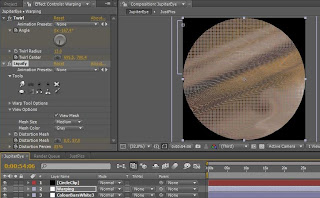
The Turbulence Displacement type was changed to a twirl effect and increased slightly to better emulate the twists and turns of the clouds of Jupiter, still without destroying the original forms of the images too much.
Another type of warp was added to make the images bulge in the centre as they move across, which further increases the impression of planetary rotation.
The images were layered a little differently over time to provide more interaction and to slow down the transitions without increasing the overall film time too much (it has only increased from 80 to 90 seconds). The sounds were layered slightly differently to accommodate the change in length.


Wednesday, 9 December 2009
Forth draft animation
I used 7 images for this animation.
Idea: Take all the things that worked from the other drafts while removing all the things that didn't! Also, I wanted to stay 'on message' with the concept, now I understand it a bit better. Most of the techniques used in this video have been used in previous drafts, but in different ways and different configurations.
Form: In the second animation draft where I tried to emulate the forms of the planet, with the spot and the line clouds , didn't work and looked really cheesey. The photographs already have beautiful forms, but they don't have colour or movement, so I decided to add colour and movement to reflect Jupiter, while keeping the forms of the original images.
Colours: After sharpening and applying a contrast curve, the photographs were coloured. The three major colours of Jupiter are beige/brown, white and dark red. The colourless photographs were recoloured to match those: first, the whole thing is 'colourized' to beige/brown; the high-luminance parts were then recoloured using 'Change to Color' to make them white and washed out (I also slightly changed the hue to a purple that seemed to fit well at the edges of the spots). Likewise, the very dark parts were recoloured to red.
Movement: Each photograph moves slowly horizontally in the frame, behind the circular clipping mask, to emulate planetary rotation. A subtle liquid effect is applied to give the surface forms a little bit of movement, like rolling storm clouds--the effect used was 'turbulence displacement', set to warp only vertically. Each image layer is staggered over time and the opacity animated, just like in all the other videos; however, the blending mode was change to 'Exclusive' (instead of 'Screen') so the images interact with each other in more interesting ways during the transitions.
Sound: The animation is about 1min and 20sec long.The original sound from NASA is only 45 sec. I asked one of my friend who is an Electronic music composer to make it one long sound that matches the video length and positioned so the intense parts of the sound match the intense parts of the video (large white sections).
The Jupiter sound wav file from the NASA website was looped and crossfaded (i.e., the end of one loop blends into the beginning of the next loop) .

Eye's Planet Phenomenon 4th draft from Arezoo niknafs on Vimeo.
Saturday, 5 December 2009
Third draft animation
I used 14 images of right eye for this animation!
After the feed back I received from my tutor and the other students over the second draft I decided to experiment further and use some of the effect in a slightly more subtle way rather than force the eye to look like Jupiter.
Eye's Planet Phenomenon third draft from Arezoo niknafs on Vimeo.
Second draft animation
These are the images I used to make this video,I picked these images from the same series for number of reasons:visually they show the noticeable change in eyes during the angiograms procedure , from the making animation point of view they had a strong dark dot and also these ones seemed crisp.


What I did to make this video:
- Layered the four images on top using the 'Screen' method of blending (just like you might in Photoshop)
- Animated the 'opacity' of each so that they fade in and out of each other
[An 'adjustment layer', in case you've never used one in photoshop, lets you apply one or more effects to every layer below it, without having to apply it to every layer or merge the layers to one image first]
- Added an adjustment layer with a colorize effect to make the light- and mid-tones brown, and another to make the dark tones red. Then I animated it to increase teh colorization over the course of the video.
- Added an adjustment layer to 'warp' the video, to emulate the movement of clouds on the surface. The bands were done by manual smearing, and the effect around the dot was done using the 'twirl' effect. Both were animated over time, like above.
- More adjustment layers were added to alter the hue and lightness, using masks to isolate areas and create the bands of white and red. Again, this was animated to fade in.
- Finally, the image was cropped into a circle using a black solid and an inverted mask.
Warping: The movements of Jupiter's clouds was drawn manually using a mouse and the distortion amount increases over time. The twirl effect was added at the eye. Both move around a little to best fit the current photograph.

Main Colouring: The grey images are recoloured using the 'change to color' effect to make it brown and red.

Colour Bars: The rings of the clouds were added by adjusting the hue and saturation of selected portions of the video.

Format type:
I rendered the video to the uncompressed format first to keep the highest possible quality although This gives maximum quality, but the file size is huge so I have to change the file to the a compressed video, instead of storing every frame as a fresh image, just stores the differences between frames and does a bit of clever manipulation to reduce the file size at the expense of detail where changes are subtle A MOV file is actually a 'shell' for a video. Most kind of video formats can be put into a MOV shell. The codec I used to compress this one is called H.264.
Eye's planet Phenomenon second draft from Arezoo niknafs on Vimeo.
First draft animation!
This was the first experimental draft animation .I used 32 images mixed right and left eye.


The idea was to reveal each picture in the direction of the veins but the circular mask and the speed of the reveals made it look like the slide show and made too long a video even with the short transitions.For the next draft i am going to use fewer images with slower transition and adding some effect to make it more in line with the concept,particularly colours.
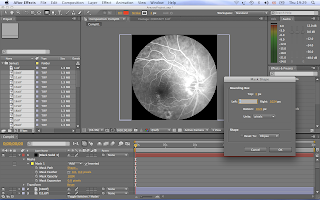
Here are some of the screenshot from the first draft animation:
Here are some of the screenshot from the first draft animation:
- This image shows how i created the circle from a solid layer and the mask:

- This image shows the photographs staggered over time:

- This image shows how I animated the size of the mask to reveal each new photograph:

- This image is the finish product before the rendering(to view the final product as a movie file can be play on computer/or burn on to the DVD ):

Following one of my friend's advice I decided to upload my video's on to Vimeo which allowed me to embed them on my blog to show the animation progress:
Wednesday, 2 December 2009
3D images!
Ready put your glasses on to see th effect:
Require Red-Cyan glasses to see the 3D/anaglyph effect :

Stereo viewer require to see the 3D/Stereo effect:

Require Red-Cyan glasses to see the 3D/anaglyph effect :

Stereo viewer require to see the 3D/Stereo effect:

Monday, 30 November 2009
John William Draper
John William Draper(1811-1822) was a scientist born in St Helens Merseyside and immigrated to USA . He became a chemistry professor in New York university. Most of his work was done in the field of photochemistry.He was one of the first scientists to use Daguerre's new invention of photography.
In March 1840, he presented the Lyceum of natural history in New York with the first representation of the moon's surface ever taken by photography in high quality by John William Draper.The silver platinum plate (Daguerreotype print) of the moon was,the first of
a series that where shot using a telescope. This series was later presented at the Science Academy.He was also the first to shoot portrait in America.He made it the subject of special study, and was the first person in the world to apply it to individuals. "The first photographic portrait from life was made by me," he says, and "the face of the sitter," his sister CatherineIn 1872 he photographed the spectrum of a Lyrae (Vega), showing dark lines, a result then unique in science, and in 1873 the finest photograph of the diffraction spectrum ever made.
The First photo of the moon 1839
http://www.fotoart.gr/photography/history/historyphotos/onephotoonestory/thefirstphotoofthemoon.htm
Pictures and diagrams
There are eight planets in our solar system :the so-called inner planets of Mercury,Venus,Earth,and Mars.Further away from the Sun are the gas giants Jupiter,Saturn Uranus and Neptune. The moon is the fifth largest satellite and also the only natural satellite in the Solar System.
Most of the patients who I photograph after looking at the fundus photograph of eye mentioning the similarity of the mages with the Moon!Few weeks ago I saw an article in Guardian Newspaper about astronomy! I scan this photo from the paper.The more I look at the Imagery of Celestial objects, the better I can recognize their fascinating visual connection with medical fundus photographs .


Jupiter

Scars from the crash of Comet Shoemaker-Levy 9 appear on Jupiter's surface as a series of maroon blotches in this photo. The comet broke into 21 pieces before it hit Jupiter in 1994. Image credit: Hubble Space Telescope Comet Team and NASA

Ganymede, a moon of Jupiter, has craters and cracks on its surface. Asteroids and comets that hit Ganymede made the craters. The cracks are due to expansion and contraction of the surface. Image credit: NASA

The planet Jupiter's Great Red Spot is a huge mass of swirling gas. At its widest, it is about three times the diameter of the Earth. Image credit: NASA

The layers of dense clouds around Jupiter appear in a photograph of the planet taken by the Voyager 1 space probe. The large, oval-shaped mark on the clouds is the Great Red Spot. The spot is believed to be an intense atmospheric disturbance. Image credit: Jet Propulsion Laboratory

Callisto, a moon of Jupiter, is covered with craters produced when asteroids and comets struck its icy surface. Beneath the surface may be an ocean of salty liquid water. Image credit: NASA
http://www.nasa.gov/worldbook/jupiter_worldbook.html
our universe is not silence!
From an original CD: JUPITER NASA-VOYAGER SPACE SOUNDS (1990) BRAIN/MIND Research
Fascinating recording of Jupiter sounds (electromagnetic "voices") by NASA-Voyager. The complex interactions of charged electromagnetic particles from the solar wind , planetary magnetosphere etc. create vibration "soundscapes". It sounds very interesting, even scary.
Jupiter is mostly composed of hydrogen and helium. The entire planet is made of gas, with no solid surface under the atmosphere. The pressures and temperatures deep in Jupiter are so high that gases form a gradual transition into liquids which are gradually compressed into a metallic "plasma" in which the molecules have been stripped of their outer electrons. The winds of Jupiter are a thousand metres per second relative to the rotating interior. Jupiter's magnetic field is four thousand times stronger than Earth's, and is tipped by 11° degrees of axis spin. This causes the magnetic field to wobble, which has a profound effect on trapped electronically charged particles. This plasma of charged particles is accelerated beyond the magnetosphere of Jupiter to speeds of tens of thousands of kilometres per second. It is these magnetic particle vibrations which generate some of the sound you hear on this recording.
Sounds like a giant metal!
http://www.inner-net.com/bmr/wsounds/jupiter.wav
Subscribe to:
Posts (Atom)